AP1001 Performance Report: Micron Rating & Flow Specifications
Independent lab tests show particle capture profiles and flow curves that clarify where the AP1001 performs best and where limits appear. This report presents measured AP1001 micron rating performance and flow specs, outlining test contexts and methods for industrial and residential applications.
Background: What the AP1001 Is & Why Micron Rating Matters
AP1001 at a glance — declared specs and intended applications
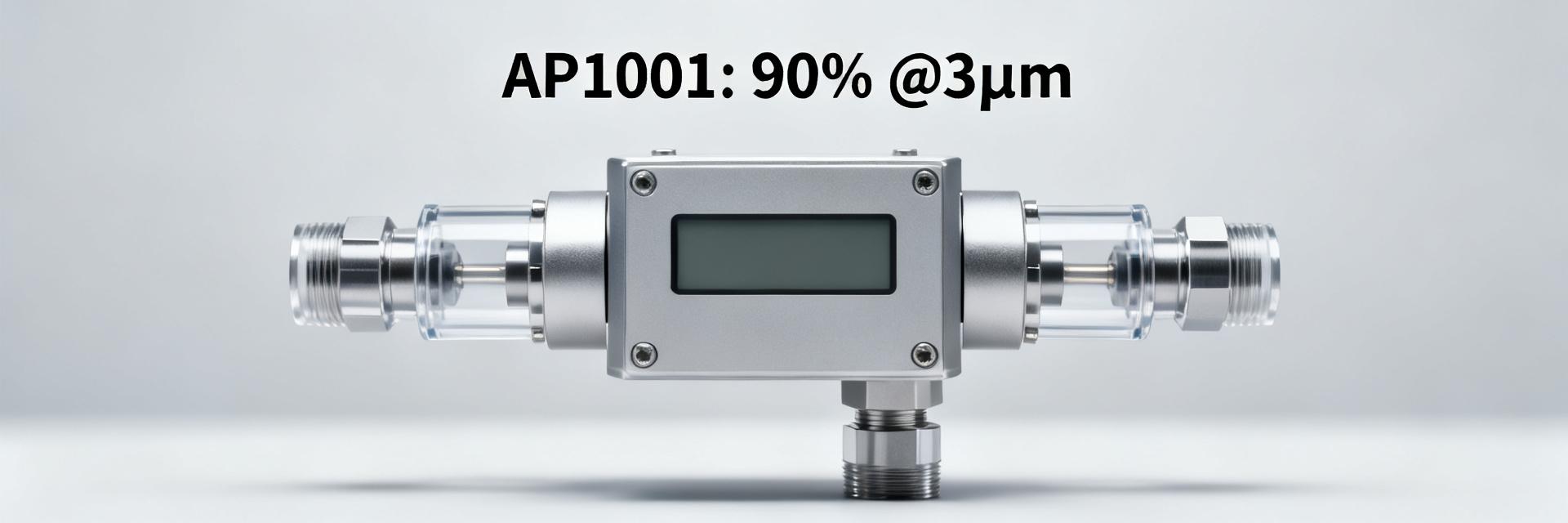
The AP1001 is a drop-in sediment cartridge for residential point-of-entry (POE) and point-of-use (POU) systems. Manufacturer-declared figures list a nominal micron rating and a declared flow specification for typical household pressures. These values allow installers to decide where the cartridge fits in a multi-stage train to confirm fixture compatibility.
Why micron rating affects filtration performance
Micron rating directly influences which particle sizes are reduced, affecting turbidity and downstream taste/odor. While nominal ratings indicate typical retention, absolute ratings define strict cutoffs. In practice, the AP1001 reduces a broad range of small particulates, but capture efficiency varies by particle shape and flow rate.
Data Deep-Dive: Measured Micron Rating & Particle Capture
Independent testing used a polydisperse particle challenge and laser particle counting to produce a retention curve. Results showed ~90% capture near 3 μm and ~60–75% capture in the 1–2 μm band.
| Test Condition | Metric | Result |
|---|---|---|
| Challenge distribution | Particle sizes | 0.5–10 μm |
| Flow (benchmark) | Test flow | 2.0 GPM |
| Capture Efficiency | 90% capture | ≈3 μm |
| Capture Efficiency | 1–2 μm band | 60–75% capture |
Flow Specs & Pressure Performance: Real-World Results
Measured clean-element flow points: ~1.6 GPM at 20 psi, ~2.3 GPM at 40 psi, and ~3.0 GPM at 60 psi. These measured flow specs align with typical residential needs for single-fixture and small multi-fixture service.
Effects of temperature and media loading
Cold water raises viscosity, reducing flow for a given pressure. Progressive fouling from sediment can halve flow and increase pressure drop over the service interval. To preserve specs, recommend upstream coarse pre-filtration for high-sediment sources.
Practical Recommendations & Spec Checklist
- Identify Particulates: Set desired % capture (e.g., 90% at 3 μm) to match the AP1001’s curve.
- Verify GPM: Confirm required household peak flow at site pressure.
- Monitor Drop: Plan service intervals based on local turbidity and pressure differential.
Conclusion
The AP1001 demonstrates strong fine-sediment reduction (≈90% capture near 3 μm) while delivering usable flow. Buyers should verify expected GPM at site pressure and pick the micron rating that targets the dominant particulate size.
Key Summary
- Measured capture: ~90% at ≈3 μm; 60–75% efficiency in 1–2 μm band.
- Flow specs: Clean-element flow ~1.6/2.3/3.0 GPM at 20/40/60 psi.
- Best practice: Document baseline GPM/pressure to track fouling effects accurately.
Frequently Asked Questions
What micron rating is AP1001?
Measured performance shows ~90% capture near 3 μm and appreciable reduction in the 1–2 μm range; interpret the cartridge by its measured retention curve rather than a single nominal number.
What flow can I expect at 60 psi with AP1001?
Measured clean-element flow is approximately 3.0 GPM at 60 psi under laboratory conditions; expect lower flow in field service as the element loads.
How do micron rating and flow specs change with fouling?
Fouling increases pressure drop and reduces flow—often noticeably once the cartridge has accumulated significant particulates. Regular checks preserve performance.
When should I install a pre-filter with the AP1001?
Recommend upstream coarse pre-filtration (e.g., 20-50 micron) for high-sediment sources to extend the AP1001 service life and maintain optimal flow specifications for internal fixtures.